One Bad Friday at a Pump Factory
A delivery slips by two weeks and three orders hang on it. Four rescue ideas go on a case board as hypotheses. One survives, and it is still only an offer.
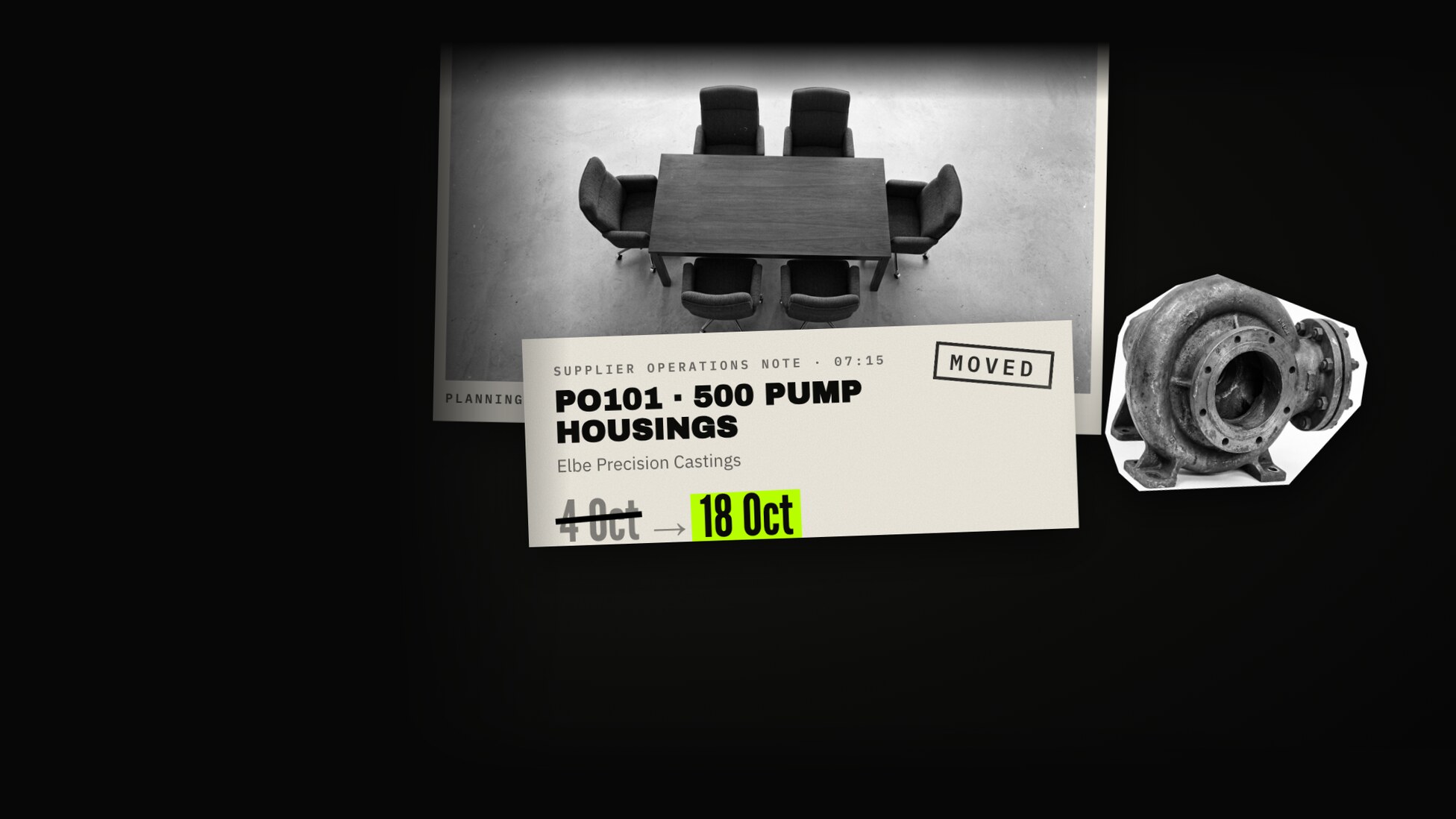
Friday, ten o’clock, Munich. Nine minutes into the planning meeting somebody says it: the housings have moved to the eighteenth.
Five hundred pump housings from Elbe Precision Castings, due on 4 October, will arrive two weeks late. Three customer orders need them between the 5th and the 7th. Together they are worth €870,000.
Everyone in the room has an idea. Hamburg has stock. Somebody found a cheap lot of a thousand. We booked a second supplier for exactly this.
The short answer: none of the three holds. Each fails for a reason that sits on a different desk: a truck slot, an engineering revision, a foundry that two suppliers share. A fourth idea arrives by memo at half past eleven. It covers every order, and it is still only an offer.
The company is invented, and so are its suppliers, its customers and every order, price, reading and date below. Any resemblance to a real company is coincidence. The workspace is real: its sources, checks, findings and cases are what you see when you open it. The counts in this article were taken on 10 October 2026.
The same story as a film
One bad Friday is this case told in five minutes.

The pictures in this article are stills from it. Paper on a black table is the film explaining; a dark browser window is the workspace itself. The photographs were generated for the film and show no real place or product.
The answer was already in the building
On a Friday like this nobody lacks data. The orders are in the ERP. The stock is in the warehouse system. The truck slots are with the carrier. And the reason the delivery moved is in a memo somebody wrote at 07:15.
What is missing is one place where those four meet. So the workspace connects seven desks:
| Source | What it holds |
|---|---|
| Company master data | Suppliers, foundries, customers, plants, machines, parts, pumps |
| Supply & orders | Orders, the purchase order and its new date, stock, truck slots, offers, the operations note |
| Purchasing & costing | Steel quotes, resin offers, the finishing-station sheet, sourcing notes |
| Machines & maintenance | Ninety days of hourly readings from 16 machines, maintenance history, handovers |
| Quality & traceability | 400 housing inspections, 2,000 final inspections, shipments, finished lots |
| Inventory control | Stock, lots, reservations and transfers in three plants |
| Data integration feeds | SAP, MES, warehouse, order-event and quality-device extracts, and the tickets that explain them |
Together that is 196 records. Eight detectors read them. Six are checks, one per desk: plain rules that say what is wrong in one sentence and show the arithmetic. This is one, word for word:
PO101 from Elbe Precision Castings (500 housings) now arrives 18 Oct, 14 days after the promised 4 Oct — too late for all 3 orders that need it.
The seventh detector finds the sentences in memos that change what is allowed. The eighth finds names and codes, so that a supplier is the same supplier wherever it is written. Both come back later.
Four ideas, each with a test
Every rescue idea goes on the case board as a hypothesis, with the test it has to pass. For the first one: if true, the stock that can reach Munich by 4 October is at least 380 housings.
1. “Hamburg has stock”
It does. Hamburg shows 260 housings. But 160 of them protect reservations and safety stock, which leaves 100 free. And the only truck slot that arrives in time carries 80.
That saves one order. €570,000 stays exposed. The check says it in its own words: “Hamburg has 100 free housings, but the only truck slot arriving by 4 Oct carries 80: 20 housings that exist cannot reach Munich in time.” Refuted.
2. “There is a cheap lot of a thousand”
A fourth order, for sanitary pumps, is short as well, and Adria Value Metals offers 1,000 housings at €145 apiece. They are revision C with industrial approval. That pump takes revision D with sanitary approval.

Whether that can be waived is not in any table. It is in the operations note, and the memo detector found the sentence and quoted it next to the price: “Revision C has a different seal interface; purchasing cannot waive this requirement.” Refuted.
3. “We are dual-sourced”
This is the comfortable one. The next hundred housings are booked with two suppliers, Elbe and Morava, and the booking sheet has two ticks on it.

One level up, both have their housings cast at the same foundry, and that foundry is down from 2 to 16 October. All 100 booked housings fall inside the outage. Two names, one foundry. Refuted, and the most dangerous of the three, because the purchasing sheet looked fine.
4. The memo at half past eleven
At 11:30 a procurement note lands. A fourth supplier offers 200 finished housings, cast at a different foundry and released by engineering for exactly these pumps.

100 in Munich, 80 from Hamburg, 200 from the new lot: 380 of 380. Every order is covered. The board moves this hypothesis to supported, at 75%, and says why it is not more: it is an offer, not stock, it expires that afternoon, and the same memo states that no purchase or transfer has been approved.

Ten o’clock is still there. The position as it was known then and the position at noon are two records on the same board. Newer evidence changed the verdict, not the history. (The labels at the sides of the board are the film’s notes; everything inside the window is the workspace.)
One supplier, four desks
Now the part no single system shows. Take one name from that Friday: Elbe Precision Castings. It is late on the purchase order. It shares a foundry with its rival. It cast the housing batch behind a quality complaint. And it is the incumbent in a steel quote.

Four desks, thirteen records, one page. A memo says “S001”, a sheet says “Elbe Precision Castings”, and both land on the same entity, because to the workspace a supplier is a thing, not a string.
The machine that was not the leak
That quality complaint: pumps are leaking in the field. There is an obvious suspect, machine M001. Its vibration has gone from 2.0 to 8.0 mm/s in a week, inside its own operating mode. That part is true, and an inspection the next day finds the bearing damaged.

But the inspections say something else. A clean batch on that machine fails 2%. The suspect batch fails 18% on a machine that is perfectly steady. The defects follow the material. The bearing needed replacing; it just was not the leak.
M001 is the same record in both cases: the failing machine in the maintenance case, and the alibi in the quality one. Without that link the bearing would have been blamed for leaks it did not cause. With it, the claim stays what it is: an association strong enough to act on, not a proven cause. No lab report exists yet, and the case says so.
Three more numbers from the same Friday

- Steel at 9% off costs €4,188 more per 10,000 usable kilograms. The price is per kilogram bought; at the cheaper supplier’s 86% yield you buy a lot more of them.
- A machine at 190 degrees. Fahrenheit: the sensor had been switched on 30 September and the label had not. It is 87.8 °C, under a 95 °C alarm.
- 380 gasket sets short. SAP’s count was a day old. The warehouse had 35 boxes of twelve: 420, against 400 needed. Nothing to buy.
Each is a finding in a different case, from a different check. The workspace holds more of the same kind: a resin deal that would expire in storage, a scrap “crisis” that was a change of product mix, a retried approval that did not reserve anything twice.
The count
Six cases. Twenty-five hypotheses. Twenty refuted.
And twelve standing questions stay on watch. One of them asks: where do two suppliers rely on the same source? It is asked by meaning, through the glossary concept “hidden shared dependency”, not by keyword, so the next scan that finds one puts it in front of you. Before the Friday.
What it does not do
It does not decide. And it will not let a figure pass for more than it is:
- Revenue at risk is exposure, not a loss.
- An offer is not stock.
- Exposed units are not defective units.
- A short window after a repair does not prove reliability.
Those caveats are written into the findings and quoted from the memos: “No purchase or transfer has been approved yet.” Somebody still has to make the call that afternoon.
Open it
The workspace is open, with every source, check, concept, standing question and case above:
showcase.classifyre.com/nova-manufacturing
Three things to try:
- Open the supply case and click a hypothesis. Its evidence lights up and the rest fades.
- Open the entity Elbe Precision Castings and read where it is mentioned.
- Open the quality case and find M001 on the board. It is the same machine you saw in maintenance.
More case files
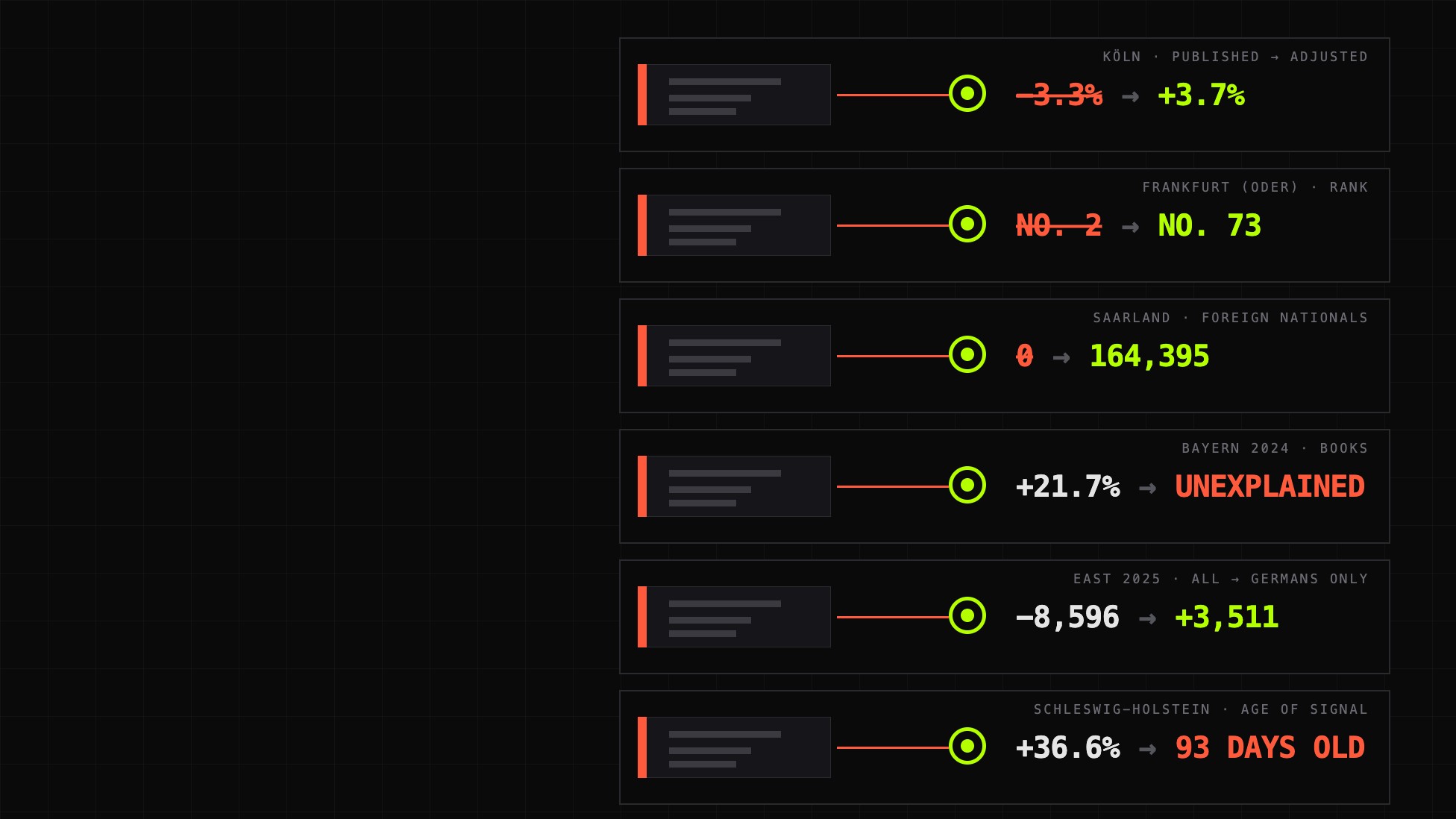
Why Germany's Official Numbers Keep Telling the Wrong Story
Every figure is correct, and the story is still wrong. We pulled real data from Destatis, the BKA and the EU into one system and went looking for the places where a true number says something false. We found six.
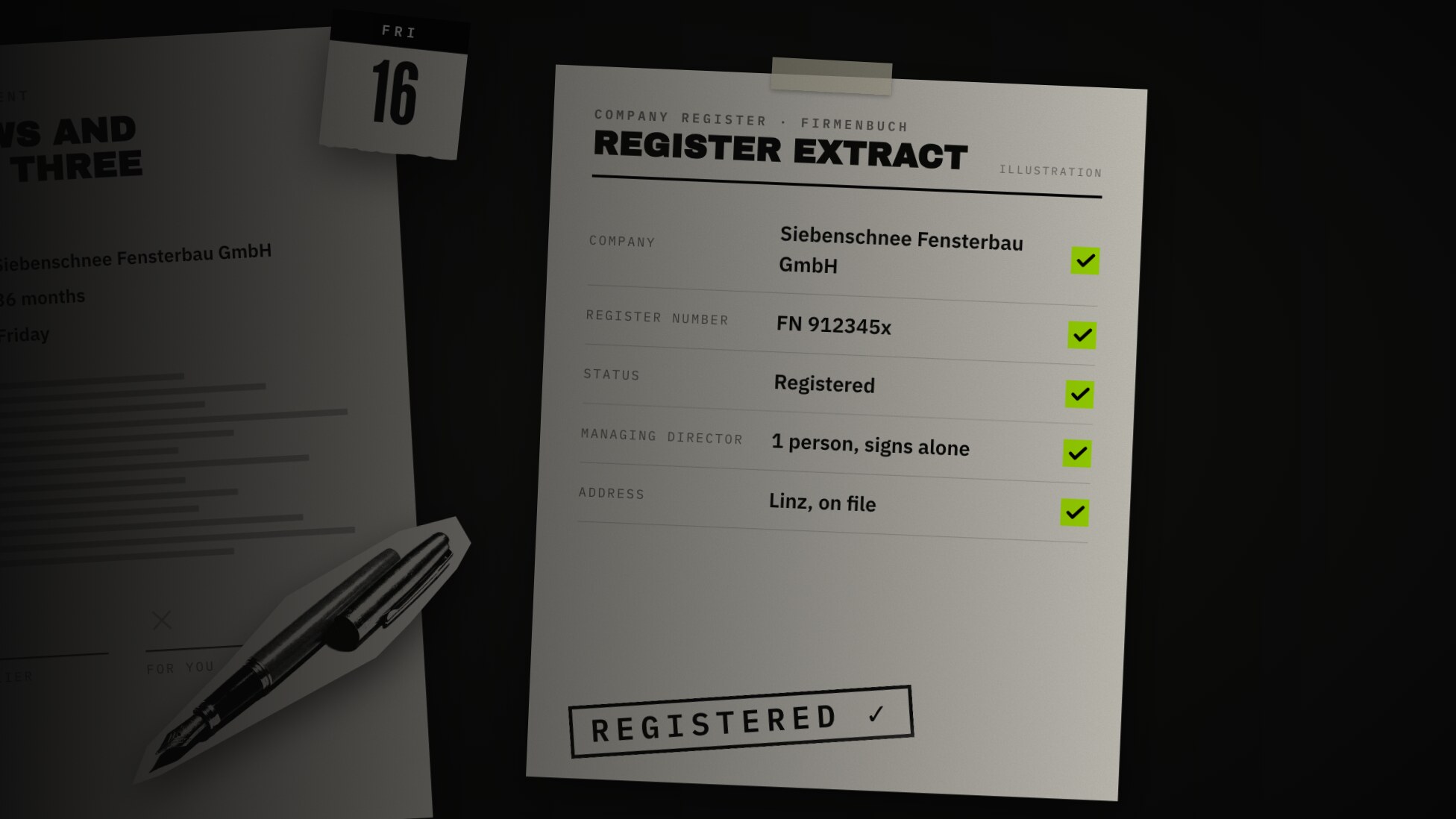
A Company Register That Watches Itself
Three cases on Austria's company register that add and drop companies on their own as filings arrive. In their first seven hours live, they took in 123 answers without a person touching them. Here is how we built them, and what they will not claim.

How AI Investigated 9,601 Hillary Clinton Emails
See how Classifyre autonomously investigated 9,601 Hillary Clinton email files, tested 20 detectors, and opened eight evidence-backed cases.