A Company Register That Watches Itself
Three cases on Austria's company register that add and drop companies on their own as filings arrive. Nobody adds a company. Nobody removes one. Here is how, and what they will not claim.
We switched the scheduler on and walked away.
Seven hours later the workspace had run 260 scans and read 8,346 records it had not seen before. Three cases had taken in 123 answers to their standing questions without anyone pressing a button. And twenty-five minutes after the start, one company’s finding had come off the early-warning list, because the next scan no longer produced it: nobody removed it, and nobody had to.
That is the whole idea of this workspace. A case that someone has to keep filling is a spreadsheet with a title. We wanted cases that keep themselves: a company enters when its filings say so, and leaves when they stop saying so.
The short answer: the Austrian company register, read for three questions that never close. Who is heading for insolvency? Which registrations are not businesses? Which companies deserve an investor’s closer look? Six public sources, nine detectors, and three cases that add and drop companies by themselves. Every flag is a register fact or a filed figure, and every flag says what it cannot know.
The numbers in this article come from two days. The opening is the first seven hours of the live run, on 7 October. Everything else was counted on 10 October 2026, four days in, when the workspace held 89,274 records and the three cases had taken in 929 answers by themselves. The live workspace is further along by the time you read this, and that is the point.
The same story as a film
Before you sign is this workspace told in six and a half minutes, from the question a supplier, a landlord or a bank asks first: who am I about to sign with?

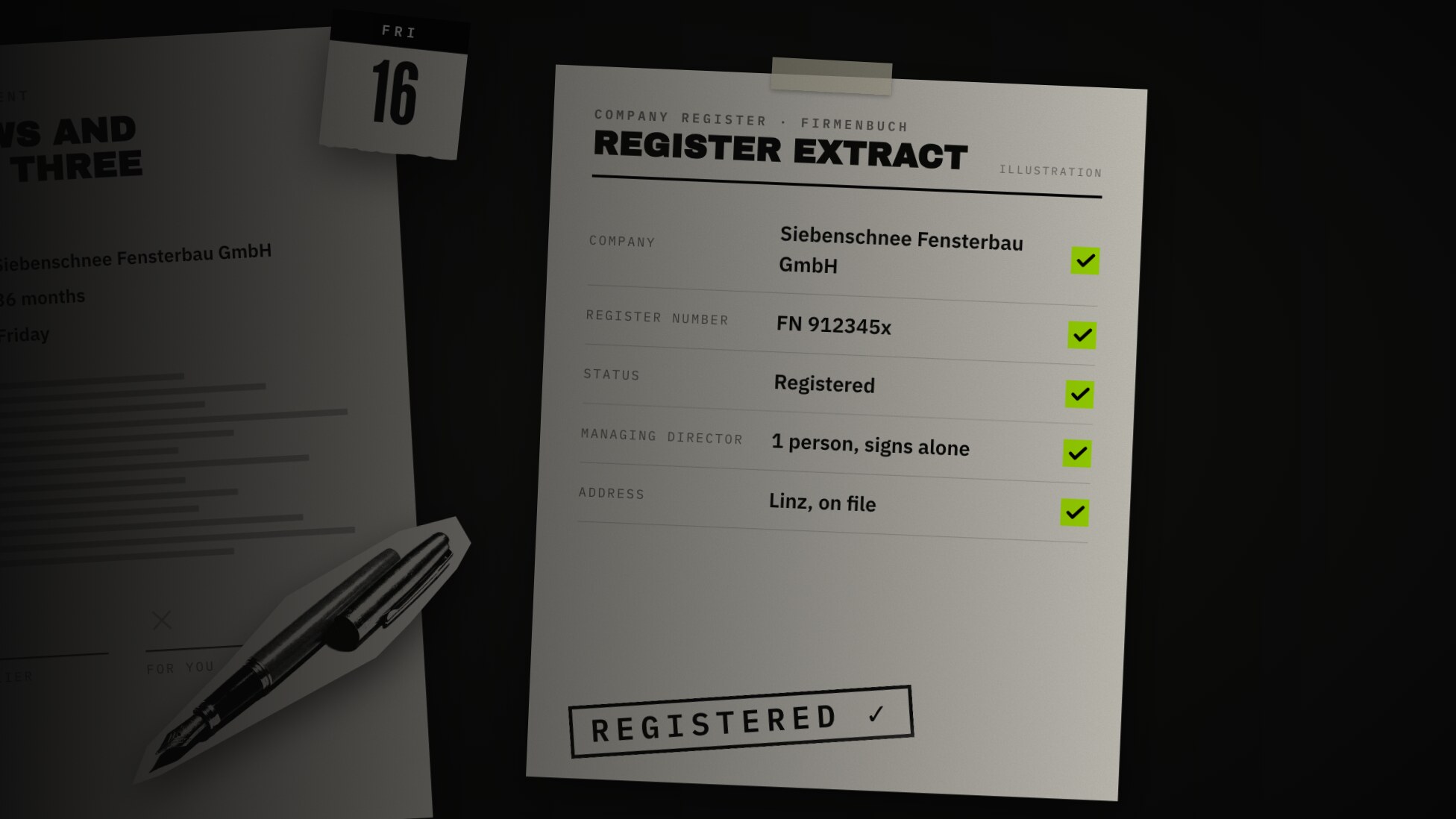
The pictures in this article are stills from the film. Every company named in them is invented, with an invented register number and invented figures, and each name was searched in the official register and matched nothing. The product screens, the rules, the counts and the hypothesis results are real.
Why we built it a second time
The first version of this workspace, in September, read the same register and did not produce cases anyone could work with. Four things were wrong, and they were all the same mistake:
- The findings were written by the connectors. Twenty-one of 23 detectors were tags. The analysis lived inside the notebooks, where a rule could not be read, tested or changed without editing a connector.
- One finding per filed year, not per company. A company with one bad 2023 stayed flagged forever, and “distress” fired on half of all filings.
- Cases did not move. Companies were attached by hand and never left. The case was a photograph of a Tuesday.
- It read everything. Every filing back to the 1990s: tens of gigabytes for a fraction of the register, and almost none of it relevant to a question about now.
The rebuild follows one rule: records state facts, rules judge. A source’s job is to say what the register says. Deciding whether that is worrying is the job of a rule you can read.
The shape of it
| Layer | What it is here |
|---|---|
| Six sources | The company register, filed accounts, financial profiles, the publication platform, trade licences, the national bank’s institution lists |
| Records | One per company (and per person holding a function), per filing, per financial profile |
| Nine detectors | Eight plain Python rules that read a record and compute every figure in their findings, and one that links every company and officer named anywhere |
| A vocabulary | 104 concepts in 11 schemes: what over-indebted, struck off or shell signal mean, in English and German |
| Standing questions | 16 saved questions that keep matching as records arrive |
| Three cases | The investigations, fed by those questions and kept by their own rules |
The register is public, and so are the sources. What you would otherwise have to build is the part in between.
Recent years only
The old version read every filing back to the 1990s. The new one reads accounts for financial years ending in the last three calendar years, plus register entries and publications from the same window. A company that left the register earlier is kept as a one-line record and nothing more is fetched for it.
That single decision is why a first scan takes minutes, and why the workspace stays small enough to run on one modest server.
One profile per company, not one finding per year
Each company gets one financial profile: its recent years side by side. A rule that wants to know whether equity is falling can see that it is falling, instead of judging each year alone. When next year’s accounts arrive, the profile changes and is judged again.
One Austrian company in five shows negative equity in a given year, often because its owners finance it with loans. So negative equity alone is not what the rules look for. They look for direction.

Rules you can read
Every rule fits on a page and says what it assumes. The early-warning rule, in plain words:
| Finding | When it fires |
|---|---|
| Acute insolvency risk | equity negative for two years running and still falling, with almost no cash against the debts |
| Newly over-indebted | equity turned negative in the latest year |
| Reorganisation need | equity below 8% of the balance sheet and debts the year’s result could not repay in 15 years (the presumption of the Business Reorganisation Act, URG §§ 22–24) |
| Equity erosion | equity still positive, but more than half of it gone |
| Persistent over-indebtedness | negative but stable or recovering: a reason to look, not an alarm |
Only companies with material debts are judged (EUR 250,000 by default), banks and insurers are left out because their balance sheets follow other rules, and a company that has left the register is not judged at all. One company gets one finding: the most serious rule that applies.
The thresholds are variables, not code. Raise the debt floor and the case gets shorter, without touching a rule.
The other detectors read the register the same way:
- Register standing: newly registered, deleted, struck off by the court, in liquidation, insolvency proceedings.
- Substance check: scores eight observations (no accounts although due, accounts stopped, no deliverable address, a manager running five or more companies, a shared address, and a few weaker ones). A company is a suspected shell from four points and on the watch at three. Each signal has an innocent explanation; only several at once make a company stand out.
- Promising company check: assets and equity each up at least 10% in both of the last two years, at least 70% of it earned rather than put in, a solid balance sheet (equity at least a quarter of it), at least EUR 500,000 in assets, and not a holding.
- Filing discipline, empty accounts, publications, trade-licence lookup, and one that links every company number and officer named anywhere to the same page.
On 10 October, among 5,198 financial profiles, the rules had flagged 208 companies as acute risk, 87 as newly over-indebted, 180 as needing reorganisation and 289 as persistently over-indebted. Eighty-two companies were promising and 103 more on the growth watch. Among 14,499 active companies on the register records, 152 were suspected shells and 203 more were on the watch.

Three cases that keep themselves
Each case is a question that does not end, with its own rule for who enters and who leaves.
| Case | Asks | A company enters when | and leaves when |
|---|---|---|---|
| Early warning: companies heading for insolvency | Who is on the way to insolvency, read early enough to matter? | its equity is negative for a second year and still falling with almost no cash, or turned negative in the latest year, on debts of EUR 250,000 or more; or an insolvency court has acted | next year’s accounts show the equity back, the proceedings end, or it leaves the register |
| Registrations without a business: suspected shell companies | Which active companies are a registration and not a business? | it collects four points on register facts | it files, gets an address, or is deleted |
| Promising companies: growth paid for by their own profits | Which companies deserve an investor’s closer look? | assets and equity grew at least 10% in each of the last two years, at least 70% of it earned, on a solid balance sheet | a year disappoints, the equity ratio drops, or it stops being in good standing |
Nobody adds or removes a company by hand. Two things do it:
Standing questions that pull. Which companies are at acute risk of insolvency? Which are already before the insolvency court? Each is a saved question that matches new findings as scans land them. The case holds a link to the question, with auto-add switched on, and every new answer is taken in.
Rules that drop. When a scan stops producing a finding, a case that asked for it takes the company off by itself. The timeline says why: finding gone, retired by the scan.
On 10 October the early-warning case held 748 records on the board, the shell case 152 and the promising case 82.
The board arranges itself around the theories
A list of companies is a result, not an investigation. Each case also states hypotheses, testable claims about the warning signs themselves, and the board is organised around them: one frame per hypothesis, with the evidence inside.
The new part is that the watches now feed the hypotheses. A watch can be told: its answers go to this hypothesis, as supporting, contradicting or neutral. From then on every answer that arrives is linked with that stance and lands inside the hypothesis’s frame, next to its card. The board is never a heap, and the balance of evidence on each hypothesis moves by itself as the scans go. The rule belongs to the case, not to the watch, so another case can read the same watch differently. How it works.

What the hypotheses say, today
We stated nine, and counted each again on 10 October. Some of the results are the point of having them.
- “Negative equity alone is not a warning.” Of 584 companies with negative equity and material debts, 289 are stable or recovering and 295 are getting worse. A rule that flagged every negative balance sheet would raise the alarm about twice as many companies as it should. That is why the rules compare years.
- “A second year of falling equity ends before the insolvency court.” Of the 295 companies at risk on their accounts, 21 are also before a court. And 363 companies are before a court in all, so 342 of them are there without that warning. Accounts are due nine months after the year they describe, so the court is often faster than the balance sheet. For anyone checking a counterparty the consequence is plain: read the accounts and the court notices.
- “A shared address on its own does not mark a shell.” 365 active companies sit at an address shared by five or more. Seven of them are suspected shells. A business park or a formation agent looks the same from the register.
- “Companies in trouble file their accounts late.” 58 of 475 companies with a distress finding filed late at least once (12%), against 359 of 4,723 other profiled companies (8%). In the first hours this looked like twice as often; with ten times the companies it is one and a half times.
- “Two good years are followed by a third.” 92 companies now have four consecutive years on file. Eight of them grew twice, and three of those grew a third time. It is too early to say, and the case says that too.
A hypothesis here carries the sentence that tests it, the counts, and the date it was tested. The notes stored on the live cases are older than these counts; when the build is run again they are replaced, and the tallies move.
It is living
Three things make this a living workspace rather than a finished report.
It keeps reading. Each source walks through the register in resumable slices and declares that it saw only part of it, so a company outside this run’s slice is never mistaken for a deleted one. The register’s change feed brings the new registrations, changes and deletions within a day; a walk through every company number reaches the dormant ones that never appear in a feed.
It keeps judging. A record that changes is judged again. A company’s finding is replaced when its accounts do, and a finding that a scan stops producing is retired. The cases follow.
It keeps a record of itself. The case timeline writes down what the case did by itself: added 14 answers from a watch, linked 44 findings to a hypothesis, took out a finding the scans no longer see. A watch that scans every few minutes reads as one growing line, not hundreds. When a company leaves a case, you can read why.
A vocabulary that does the translating
Austrian company law is full of words that mean nothing to a non-specialist and one precise thing to a specialist. We loaded 104 concepts in 11 schemes (legal forms, company standing, financial distress, business substance, growth, industries and more), each with its German and English names and the register’s own codes.
Every finding means a concept. A question is asked by concept, not by string, so “over-indebted”, Überschuldung and the register’s own code find the same records. And companies and people are entities: a mention of a company number or an officer, in any source, lands on that company’s or person’s page. On 10 October the workspace knew 15,260 companies and 19,400 people.

What it will not claim
A tool that implies more than it has is worse than one that admits less.
No profit and no revenue for most companies. Small companies under § 278 UGB are not required to publish a profit and loss account. Growth here is read from the balance sheet across years, and the “year’s result” is the change in accumulated profit.
A refusal is a finding, not a silence. The trade-licence register refuses per-company lookups to our key. Instead of dropping that into a log, each refusal is recorded: 5,050 lookups carry a trade licence unknown finding, so no case can read “no licence” into “we were not allowed to ask”.
The register is only partly walked. For any company the honest answer is the data, or “not scanned yet”, never “nothing found”.
A flag is a reason to look. Book over-indebtedness is never a finding of insolvency: whether a company can carry on is a forecast no filing contains. The promising list is a shortlist, not advice: the register does not say who owns a company, whether it is for sale, or who its customers are.
Nothing in this article names a real company, and nothing in the workspace accuses one. The companies named in the film and in its stills are invented. A flag is built from public filings and can be wrong.
How it was built
Almost entirely through Classifyre’s own MCP server. The six connectors are notebooks, the nine rules are Python files, and the glossary, the questions, the cases and their hypotheses are all declared in code and created through the same tool surface that reads them back: create, push, run, read, adjust. The one thing we did not rewrite is the part that talks to the register; the fetching and parsing code is the same, tested code from the first version.
See it yourself
The workspace is live, with every rule, question, case and hypothesis described above:
showcase.classifyre.com/firmenbuch-austria
Open one of the cases and look at the timeline: it tells you what the case did since you last looked. Then open the Watches panel, and see which hypothesis each question feeds.
More case files
One Bad Friday at a Pump Factory: Four Rescue Ideas, and the One the Evidence Left Standing
A delivery slips by two weeks and three orders hang on it. Four rescue ideas go on a case board as hypotheses, and one survives. A case file on Nova Manufacturing: an invented pump maker on a real workspace.
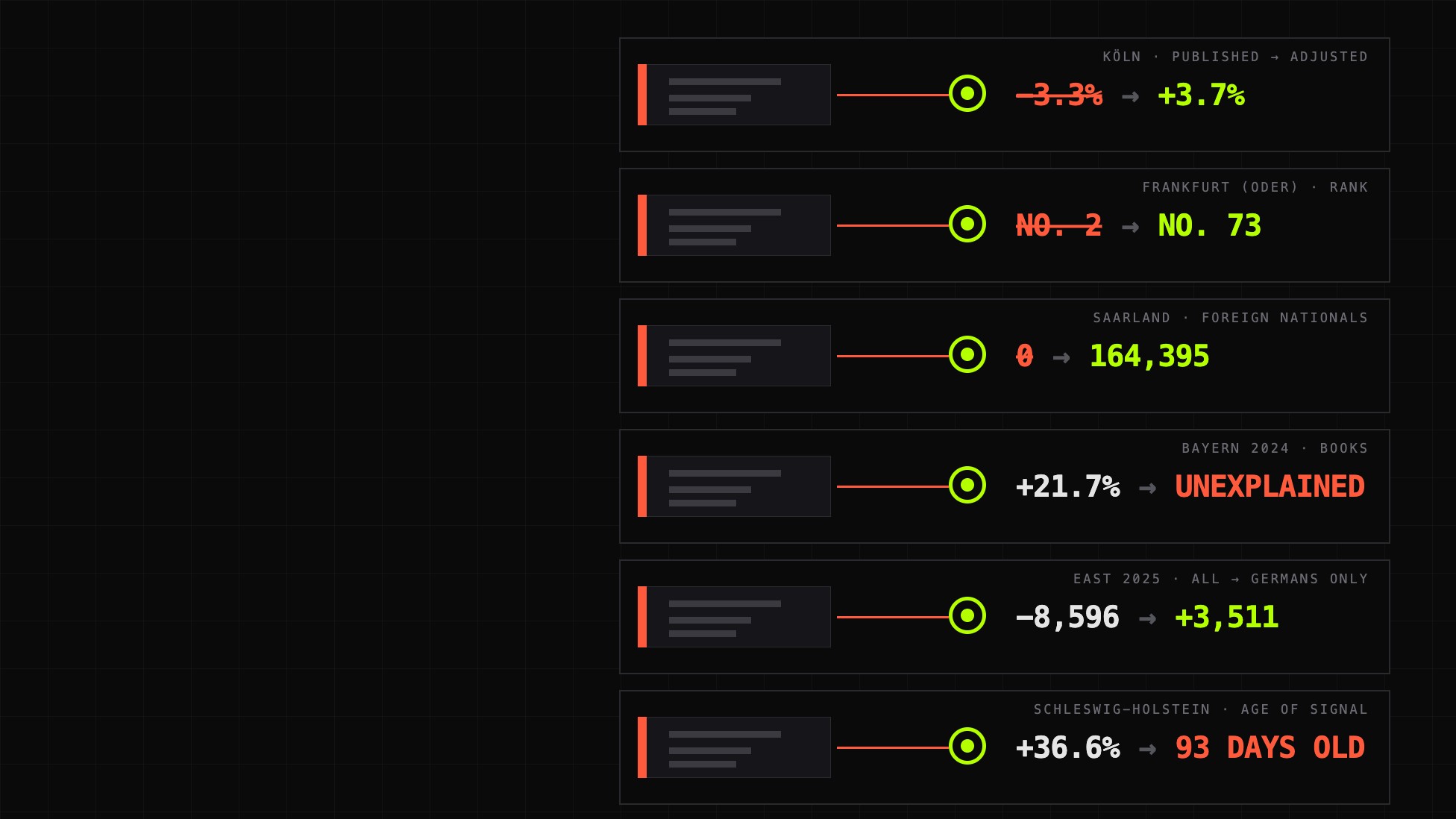
Why Germany's Official Numbers Keep Telling the Wrong Story
Every figure is correct, and the story is still wrong. We pulled real data from Destatis, the BKA and the EU into one system and went looking for the places where a true number says something false. We found six.

How AI Investigated 9,601 Hillary Clinton Emails
See how Classifyre autonomously investigated 9,601 Hillary Clinton email files, tested 20 detectors, and opened eight evidence-backed cases.